When should you replace a concrete driveway? There isn’t one answer that fits every slab. A driveway with a chipped corner may need a small repair. A driveway that rocks under a truck, holds water near the garage, and has cracks running through several panels deserves a much closer look.
That’s where we start. Not with the age of the driveway. Not with a photo taken from the curb. We look at what the concrete is doing and how the property is being used.
M Concrete Group replaces and installs concrete driveways in Richardson and nearby North Dallas communities. When we visit a home, we check the damaged areas, but we also walk the full driveway. The street connection matters. The garage entrance matters. Drainage matters. Even the way a driver turns into the space may matter.
Is the driveway ugly, damaged, or both?
Homeowners often call after living with a bad-looking driveway for years. It may be stained, patched in several places, or faded to different shades. None of that automatically means the slab has failed.
Then there are driveways that look decent from a distance but feel wrong underfoot. One panel may sit higher than the next. A corner may move when a vehicle crosses it. Water may settle into the same low spot after every rain.
Appearance and movement lead to different conversations. If the concrete is stable and the concern is mainly cosmetic, replacement is a choice rather than an urgent structural need. If several sections have shifted, the work may need to include the material below the slab, new elevations, or both.
We make that distinction during the estimate. It gives the homeowner a clear reason for the proposed scope.
Take a slow walk after it rains
A sunny-day estimate can hide half the story. If rain is in the forecast, watch the driveway for a few minutes. Where does the roof water land? Does runoff cross the concrete? Is water sitting near the garage door an hour later? Take pictures.
Those pictures are useful. They show conditions that may be gone by the time we arrive.
A low panel can hold water. Soil missing from an edge can leave part of a slab without even support. A downspout may send a steady stream across one corner. More than one issue may be present, which is why a single patch doesn’t fit every drainage problem.
New concrete needs a planned path for water. The street, garage floor, walks, existing drains, and neighboring property place limits on that plan. At some homes, correcting the driveway grade is enough. At others, drainage work may need to be priced separately or coordinated with another contractor.
Now look at the cracks
How many are there? Are they thin and level, or can you feel a height change when you drag your shoe across them? Have they stayed about the same, or have they opened farther over time?
Concrete can crack under a range of site and weather conditions. Joints give movement a planned location, though cracks don’t always stay inside those lines. We won’t promise a crack-free driveway.
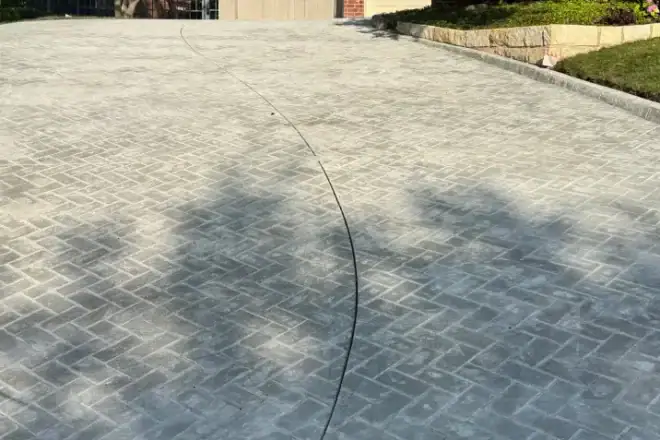
A stable crack in one panel may remain a repair question. A wide opening with movement on each side may point to a support problem under the concrete. Filling the opening changes the top of the slab. It doesn’t put missing material back under it.
A group of cracked and moving panels usually deserves a replacement discussion. That discussion may cover part of the driveway or the whole driveway. The answer depends on where the damage stops and whether the remaining concrete is worth keeping.
Broken edges can reveal how the driveway is used
The outer edge of a driveway takes plenty of abuse. Tires drop off it. Delivery trucks turn across it. Trailers clip the same corner. Sometimes runoff has carried soil away from the side.
One broken corner may be limited work. A long line of broken edges is different. We look at slab support, thickness, reinforcement, and the path vehicles take across the property.
Tell us what uses the driveway. Daily cars are obvious. Moving trucks, work trailers, recreational vehicles, refuse trucks, and frequent deliveries are easy to forget during an estimate. Their size and travel path belong in the project conversation.
Tree roots, irrigation, utility lines, and recent underground repairs belong there too. What sits beside or under the driveway may limit excavation or call for coordination before concrete work begins.
When another repair starts to feel like another bill
Many homeowners don’t mind making a practical repair. They mind paying for the same trouble again and again.
Maybe one panel was patched last year. Now the panel beside it has settled. Maybe the garage approach has been filled more than once, yet the opening returned. At that point, it makes sense to compare another repair with a replacement scope.
Ask what each option actually changes. A surface patch handles a surface area. A panel replacement allows the crew to remove that section and examine the exposed base. A complete driveway replacement allows new grading, preparation, reinforcement, elevations, and joints across the approved area.
The larger option isn’t automatically the right one. The smaller option isn’t automatically the better value. The condition of the driveway, the expected use, and the homeowner’s plans should drive the choice.
What should be in a driveway replacement quote?
This part should be boring in the best way. Clear measurements. Clear materials. Clear responsibilities.
The quote should identify demolition and hauling, excavation, base preparation, forming, reinforcement, concrete placement, finish, joints, cleanup, and any drainage items included. If the driveway width or layout will change, the proposal should show the approved dimensions.
Permits, utility work, landscape repair, irrigation, surveys, and work by other trades should be listed when they are included. If they aren’t included, that should be clear as well.
Ask about timing in two parts. First, how long will removal and installation take? Second, when can people walk or drive on the new concrete? Weather, access, pour size, and site conditions may change the calendar. Your contractor should explain the plan for your project rather than give a blanket answer.
This may be the right time to change the layout
A replacement doesn’t have to copy a driveway that has never worked well. Some homeowners need one more parking space. Others want a wider approach or a cleaner connection to a walkway.
Bring that up before pricing is final. Added concrete needs the same planning as the original driveway, including support, reinforcement, joints, and drainage. It also has to fit the property.
An extension may be limited by a property line, easement, utility, setback, or city requirement. A site measurement can tell us what physically fits. The homeowner may still need a survey or approval for the proposed change.
M Concrete Group also installs sidewalks, flatwork, and decorative concrete. When one of those areas connects directly to the driveway project, we can discuss whether it belongs in the same scope.
What working with us looks like
We begin by listening. What bothers you about the driveway? Is it water, cracking, parking room, the garage approach, or the overall look? Has the problem changed? What vehicles use the space?
Then we walk it. We review measurements, access, grade, drainage, and connections to the street, garage, and other concrete. The written quote describes the work we’re proposing.
Stephen stays involved, and our team handles the preparation and concrete work in the approved scope. That includes the parts you’ll never see once the driveway is finished: excavation, grading, base preparation, forms, and reinforcement.
M Concrete Group is based in Richardson. We serve Plano, Irving, Frisco, McKinney, Highland Park, University Park, Preston Hollow, North Dallas, and nearby areas when the scope and schedule fit.
Ready to talk about your driveway?
Call or text 214.399.1489 or send us a message through the M Concrete Group contact form. Tell us what you’ve noticed and how long it has been happening. If rain or vehicle traffic makes the trouble easier to see, send a few photos. We can use that information to begin the conversation and arrange an on-site review when needed.