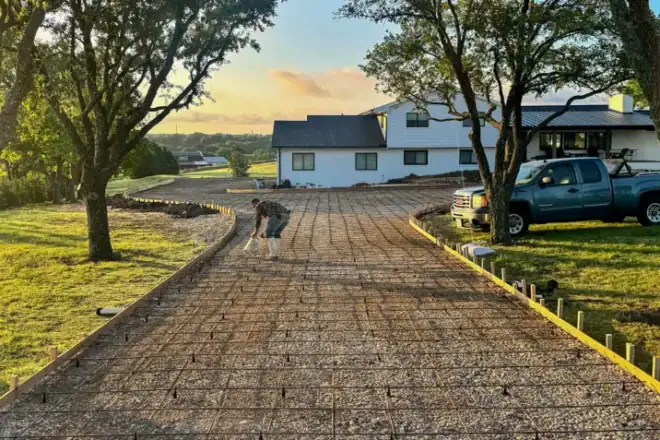
Planning a decorative concrete patio is much easier when you stop thinking about the concrete for a minute.
Picture a normal Saturday instead. Someone is at the grill. Four people are sitting around the table. A kid runs from the back door to the yard. Two chairs are pulled away from the table, and now nobody can get past them.
That little scene tells us more about the right patio size than a square-foot number by itself.
M Concrete Group installs decorative concrete patios, hardscapes, and flatwork in Richardson and the North Dallas area. We talk through how the space will be used, what it needs to connect to, and where water will go before the pattern and color are finalized.
Start with furniture, not a concrete sample
Stamped patterns and colors are fun to look at. Start with the less exciting question: what needs to fit?
Make a quick list. Dining table. Grill. Smoker. Lounge chairs. Planters. Storage box. Maybe a fire feature. Maybe nothing more than two rocking chairs and room to stretch out.
Next, mark the patio on the ground. A garden hose works well for a curved edge. Stakes and string work for straight lines. Put the actual chairs inside the outline if you have them. Use cardboard boxes for anything that hasn’t been purchased yet.
Then walk through it. Open the back door. Pull out a chair. Carry an imaginary tray from the kitchen to the table. Stand at the grill and see who would need to squeeze behind you.
It may feel a little silly. Do it anyway. A patio can look generous on a sketch and feel cramped once furniture takes its share.
Don’t design around a party you host once a year
It is easy to plan for the biggest crowd you can imagine. That may leave a large surface that sits mostly empty.
Think about the people who will use the patio every week. A couple who eats outside may want shade, two comfortable chairs, and a small table. A family that cooks outdoors may need a clear work area near the grill and a dining area outside the smoke path.
Occasional guests still count. They just shouldn’t be the only factor. Extra seating may work in the yard or along a wide patio edge when company comes over.
The right size is personal. We can measure and price the concrete. The homeowner has to decide how much outdoor space feels useful and how much yard should remain open.
Walk out the back door and look down
The patio has to meet the house somewhere. That connection can set the elevation for much of the project.
Look at the door threshold. Is there already a step? Does the door swing over the planned area? Is another door or gate nearby? A low threshold may limit the concrete height. A high threshold may call for a step or landing.
Now look beyond the door. The patio may need to meet a walkway, lawn, pool deck, garden border, fence opening, or existing slab. Every meeting point needs a workable height and a comfortable route.
Share future plans at this stage. A patio cover may need footings. An outdoor kitchen may need gas, electrical, water, or drain work. A spa or fire feature may come with its own placement and support requirements. Those details are harder to add after the concrete is already in place.
Rain gets a vote
Spend a few minutes in the yard during a good rain. You may see water that never appears on a dry estimate day.
Watch the downspouts. Look for a low place near the house. Notice whether water crosses the proposed patio area on its way to a side yard or drain. A phone video can capture the route.
The patio needs an elevation and slope that move surface water away from the house toward an appropriate outlet. The available route depends on the door height, yard grade, neighboring property, existing drains, and other fixed conditions.
Some yards have room for a straightforward grading plan. Others may need drainage work or coordination with another contractor. We want that discussion before the forms are set, not while the concrete truck is on the way.
Now pick the look
Here comes the part most homeowners have been waiting for.
Stamped concrete can add a pattern that resembles stone, brick, tile, or another material. Stained concrete changes the color of the slab. A contrasting border can frame the space. A broom finish offers a simpler texture and appearance.
Bring photos of patios you like. They help us understand whether you lean traditional, rustic, clean, or understated. Treat the photos as direction rather than an exact color promise. Light, shade, concrete variation, color products, application, and sealer may change how the finished surface looks.
Texture matters in daily use. Deep patterns may make a chair wobble. A finish near a pool or uncovered step needs appropriate traction. A dark surface in direct sun may feel warmer than a lighter surface under similar exposure. The final choice should fit where the patio sits and how people will use it.
Ask how you’ll care for it
A decorative patio isn’t maintenance-free. It will collect dirt, pollen, leaves, spills, and whatever the dog brings in from the yard.
Ask how the selected finish should be cleaned. Some decorative systems may need resealing. The timing depends on the finish, product, traffic, sun, weather exposure, and maintenance history. There isn’t one schedule that applies to every patio.
Planters, grill mats, furniture feet, and metal objects can hold moisture or leave marks. Follow the care directions for the finish that was installed. Avoid using a cleaner until you know it is suitable for the surface and sealer.
A pretty finish still needs ordinary concrete work
Under the pattern and color is a concrete slab. It needs a prepared area, planned elevations, forms, reinforcement, joints, placement, finishing, and curing.
This is where a patio photo tells you very little. You can see the border. You can’t see how the ground was prepared or what reinforcement was placed before the pour.
During an estimate, ask what is included below the visible surface. The quote should describe demolition when needed, excavation, base preparation, forming, reinforcement, slab details, concrete, joints, and cleanup.
Concrete may crack under some conditions. Joints provide planned lines for movement, but a crack may still appear outside a joint. We won’t promise a crack-free patio.
Can the crew reach the yard?
A backyard patio may sit only thirty feet from the street, yet the route can turn it into a much more involved job.
Walk from the driveway to the proposed patio. How wide is the gate? Are there steps? Air-conditioning equipment? A pool? New landscaping the homeowner wants protected? Is there room for demolition material to leave and new material to enter?
Restricted access may change the equipment, crew time, and placement plan. Existing fences or landscaping may need temporary work, but only when that work appears in the approved scope.
Be direct about anything that cannot be disturbed. The contractor needs to see the route before final pricing, and the homeowner needs to understand which restoration items are included.
Get the choices onto the quote
A good patio quote should make the finished project easy to picture. It should list the approximate size and shape, selected finish, color method, pattern, border, and sealer when those items are part of the work.
It should also cover the work underneath: removal, excavation, base, forms, reinforcement, slab details, concrete, joints, cleanup, and curing instructions. Steps, walkways, drains, footings, and connections need their own descriptions when included.
Then check the exclusions. Landscaping, irrigation, utility work, permits, surveys, patio covers, outdoor kitchens, and electrical or plumbing work may belong to other contractors. Nobody should have to guess.
Square-foot price can be a starting point, but it doesn’t describe curves, several colors, restricted access, demolition, drainage, borders, or related work. Compare the full scope.
Let’s talk about the patio you’ll actually use
M Concrete Group is based in Richardson and serves Plano, Irving, Frisco, McKinney, Highland Park, University Park, Preston Hollow, North Dallas, and nearby communities when the scope and schedule fit.
Call or text us at 214.399.1489 or use our contact form to request a decorative concrete patio quote. Send a few yard photos, rough measurements, finish ideas, and notes about future covers or outdoor features. We’ll start with the space and how you want to use it. The concrete plan comes from there.